
Skip to content
  • General
  • Programming
  • DS & Algo
  • System Design
  • Interview Questions
  • Home
  • YouTube
  • About
  • Contact
Learn to Code and Code to Learn

Learn to Code and Code to Learn

Your Journey to Code Mastery

  • General
    • Setup
  • Programming
    • C++
    • C++-11
    • c++-14
    • Python
  • DS & Algo
    • DS
    • Algo
      • Competitive Programming
        • Leetcode Problems
  • System Design
    • Design Pattern
    • SOLID Principle
  • Interview Questions
    • C++
    • Company Wise
  • Toggle search form

Array in C programming

Posted on January 12, 2024January 31, 2024 By thecodepathshala No Comments on Array in C programming

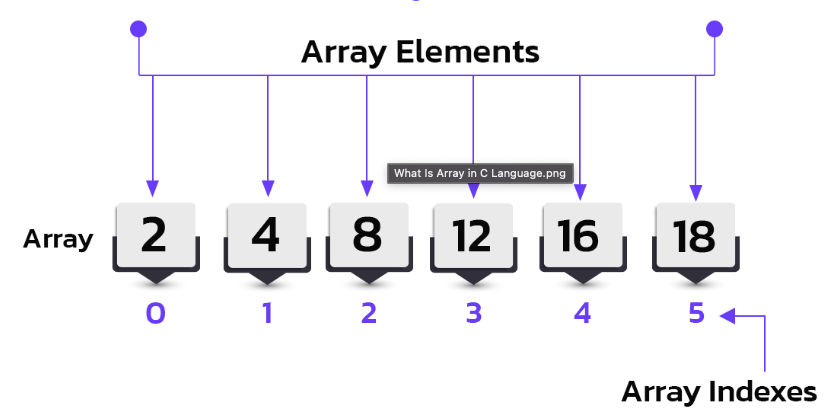
Arrays a kind of data structure that can store a fixed-size sequential collection of elements of the same type.

An array in C is a fixed-size collection of similar data items stored in contiguous memory locations. It can be used to store the collection of primitive data types such as int, char, float, etc., and also derived and user-defined data types such as pointers, structures, etc.
Declaring Arrays

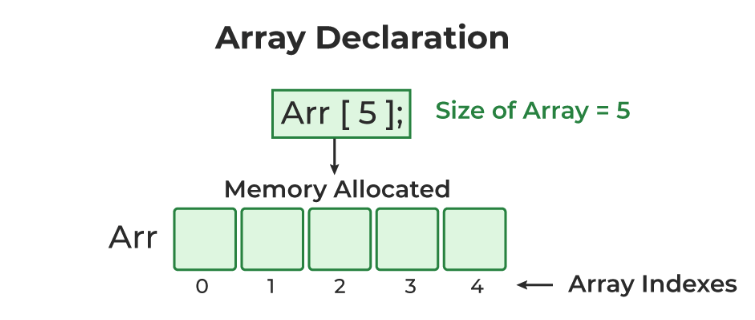
In C, we have to declare the array like any other variable before using it. We can declare an array by specifying its name, the type of its elements, and the size of its dimensions. When we declare an array in C, the compiler allocates the memory block of the specified size to the array name.

Syntax :

data_type array_name [size]; // Single dimensional array
         or
data_type array_name [size1] [size2]...[sizeN]; // Multi dimensional array
Array Initialization :

Initialization in C is the process to assign some initial value to the variable. When the array is declared or allocated memory, the elements of the array contain some garbage value. So, we need to initialize the array to some meaningful value. There are multiple ways in which we can initialize an array in C.

1. Array Initialization with Declaration with size :

In this method, we initialize the array along with its declaration. We use an initializer list to initialize multiple elements of the array. An initializer list is the list of values enclosed within braces { } separated b a comma.

data_type array_name [size] = {value1, value2, ... valueN};

2. Array Initialization with Declaration without Size :

If we initialize an array using an initializer list, we can skip declaring the size of the array as the compiler can automatically deduce the size of the array in these cases. The size of the array in these cases is equal to the number of elements present in the initializer list as the compiler can automatically deduce the size of the array.

The size of the arrays is 5 which is automatically deduced by the compiler.

data_type array_name[] = {1,2,3,4,5};

3. Array Initialization after Declaration (Using Loops) :

We initialize the array after the declaration by assigning the initial value to each element individually. We can use for loop, while loop, or do-while loop to assign the value to each element of the array.

for (int i = 0; i < N; i++) {
    array_name[i] = valuei;
}

Example of Array Initialization in C

// C Program to demonstrate array initialization
#include <stdio.h>
int main()
{ 
    // array initialization using initialier list
    int arr[5] = { 10, 20, 30, 40, 50 };
 
    // array initialization using initializer list without
    // specifying size
    int arr1[] = { 1, 2, 3, 4, 5 };
 
    // array initialization using for loop
    float arr2[5];
    for (int i = 0; i < 5; i++) {
        arr2[i] = (float)i * 2.1;
    }
    return 0;
}

Access Array Elements

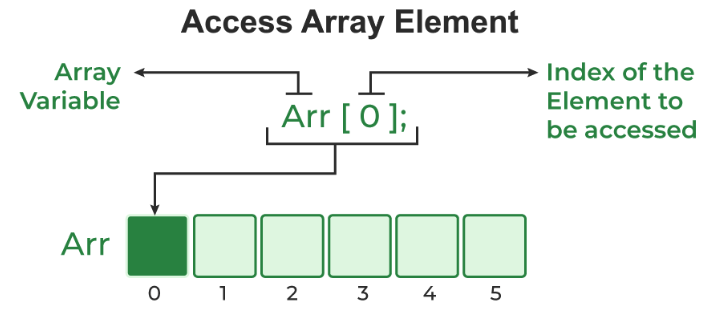
We can access any element of an array in C using the array subscript operator [ ]  and the index value i of the element.

array_name [index];

One thing to note is that the indexing in the array always starts with 0, i.e., the first element is at index 0 and the last element is at N – 1 where N is the number of elements in the array.
Example of Accessing  Array Elements using Array Subscript Operator

// C Program to illustrate element access using array
// subscript
#include <stdio.h>
 
int main()
{
 
    // array declaration and initialization
    int arr[5] = { 15, 25, 35, 45, 55 };
 
    // accessing element at index 2 i.e 3rd element
    printf("Element at arr[2]: %d\n", arr[2]);
 
    // accessing element at index 4 i.e last element
    printf("Element at arr[4]: %d\n", arr[4]);
 
    // accessing element at index 0 i.e first element
    printf("Element at arr[0]: %d", arr[0]);
 
    return 0;
}

/*
Element at arr[2]: 35
Element at arr[4]: 55
Element at arr[0]: 15
*/

Simple program to use of array :

// C Program to demonstrate the use of array
#include <stdio.h>
int main()
{
    // array declaration and initialization
    int arr[5] = { 10, 20, 30, 40, 50 };
 
    // modifying element at index 2
    arr[2] = 100;
 
    // traversing array using for loop
  printf("Elements in Array: ");
    for (int i = 0; i < 5; i++) {
        printf("%d ", arr[i]);
    }
    return 0;
}

/*
Elements in Array: 10 20 100 40 50 
*/

Update Array Element :

We can update the value of an element at the given index in a similar way to accessing an element by using the array subscript operator [ ] and assignment operator =.

array_name[i] = new_value;

C Array Traversal :

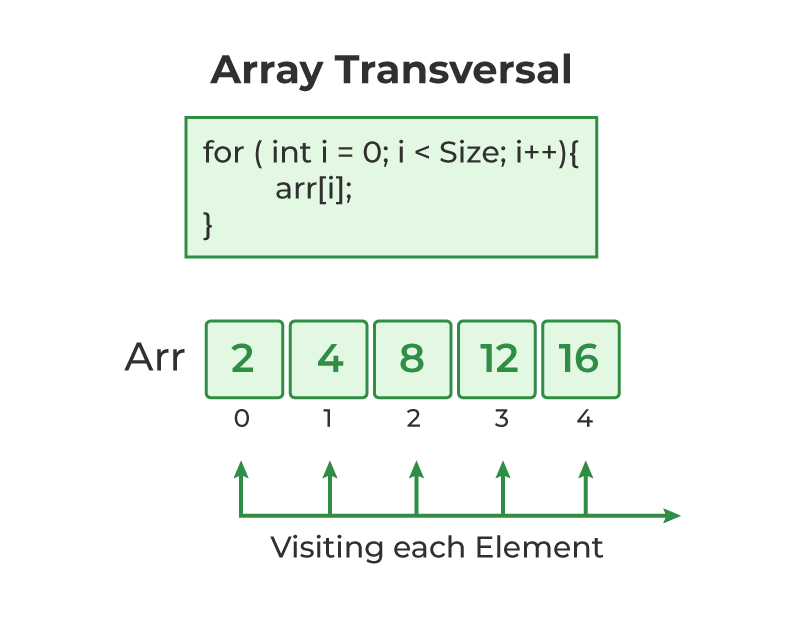
Traversal is the process in which we visit every element of the data structure. For C array traversal, we use loops to iterate through each element of the array.
Array Traversal using for Loop :

for (int i = 0; i < N; i++) {
    array_name[i];
}
c array traversal

Types of Array in C

There are two types of arrays based on the number of dimensions it has. They are as follows:

  1. One Dimensional Arrays (1-D Array)
  2. Multidimensional Arrays (2-D, 3-D)

One Dimensional Array in C

It is also known as 1-D arrays in C. The One-dimensional arrays are those arrays that have only one dimension.

Syntax : 

array_name [size];
Example of 1-D array

Array of characters(String)

In C, we store the words, i.e., a sequence of characters in the form of an array of characters terminated by a NULL character.

// C Program to illustrate strings
#include <stdio.h>
int main()
{
	// creating array of character
	char arr[6] = { 'G', 'e', 'e', 'k', 's', '\0' };

	// printing string
	int i = 0;
	while (arr[i]) {
		printf("%c", arr[i++]);
	}
	return 0;
}

/*
Output :
Geeks
*/

Multidimensional Array in C

Multi-dimensional Arrays in C are those arrays that have more than one dimension. Some of the popular multidimensional arrays are 2D arrays and 3D arrays.

A. Two-Dimensional Array in C

A Two-Dimensional array or 2D array in C is an array that has exactly two dimensions. They can be visualized in the form of rows and columns organized in a two-dimensional plane.

Syntax of 2D Array in C:

array_name[size1] [size2];

Here, 
size1: Size of the first dimension.
size2: Size of the second dimension.
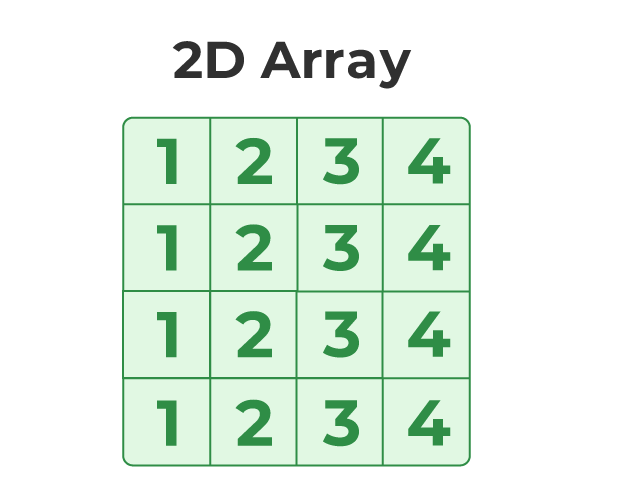
2d array in c

Example of 2D Array

// C Program to illustrate 2d array
#include <stdio.h>

int main()
{

	// declaring and initializing 2d array
	int arr[2][3] = { 10, 20, 30, 40, 50, 60 };

printf("2D Array:\n");
	// printing 2d array
	for (int i = 0; i < 2; i++) {
		for (int j = 0; j < 3; j++) {
			printf("%d ",arr[i][j]);
		}
		printf("\n");
	}

	return 0;
}

/*
Output: 
2D Array:
10 20 30 
40 50 60 
*/

Three-Dimensional Array in C

Another popular form of a multi-dimensional array is Three Dimensional Array or 3D Array. A 3D array has exactly three dimensions. It can be visualized as a collection of 2D arrays stacked on top of each other to create the third dimension.

Syntax of 3D Array in C

array_name [size1] [size2] [size3];
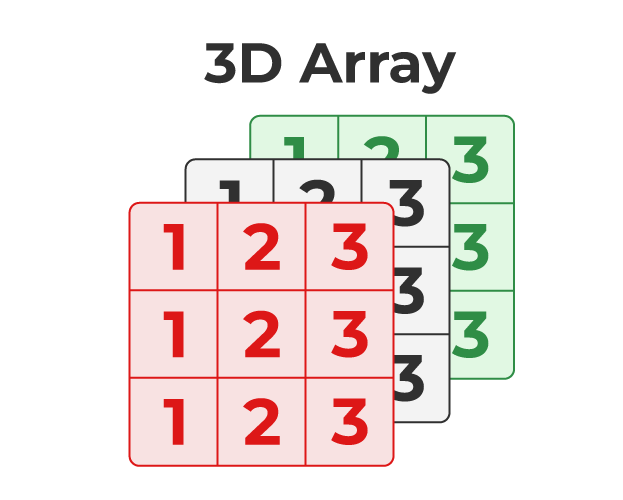
3d array in c

Example :

// C Program to illustrate the 3d array
#include <stdio.h>

int main()
{

	// 3D array declaration
	int arr[2][2][2] = { 10, 20, 30, 40, 50, 60 };

	// printing elements
	for (int i = 0; i < 2; i++) {
		for (int j = 0; j < 2; j++) {
			for (int k = 0; k < 2; k++) {
				printf("%d ", arr[i][j][k]);
			}
			printf("\n");
		}
		printf("\n \n");
	}
	return 0;
}

/*
Output:

10 20 
30 40 

 
50 60 
0 0 
*/

Arrays and Pointers :

Arrays and Pointers are closely related to each other such that we can use pointers to perform all the possible operations of the array. The array name is a constant pointer to the first element of the array and the array decays to the pointers when passed to the function.

// C Program to demonstrate the relation between arrays and
// pointers
#include <stdio.h>

int main()
{

	int arr[5] = { 10, 20, 30, 40, 50 };
	int* ptr = &arr[0];

	// comparing address of first element and address stored
	// inside array name
	printf("Address Stored in Array name: %p\nAddress of "
		"1st Array Element: %p\n",
		arr, &arr[0]);

	// printing array elements using pointers
	printf("Array elements using pointer: ");
	for (int i = 0; i < 5; i++) {
		printf("%d ", *ptr++);
	}
	return 0;
}

/*
Output :

Address Stored in Array name: 0x7ffce72c2660
Address of 1st Array Element: 0x7ffce72c2660
Array elements using pointer: 10 20 30 40 50 
*/

Passing an Array to a Function in C

An array is always passed as pointers to a function in C. Whenever we try to pass an array to a function, it decays to the pointer and then passed as a pointer to the first element of an array.

// C Program to pass an array to a function
#include <stdio.h>

void printArray(int arr[])
{
	printf("Size of Array in Functions: %d\n", sizeof(arr));
	printf("Array Elements: ");
	for (int i = 0; i < 5; i++) {
		printf("%d ",arr[i]);
	}
}

// driver code
int main()
{

	int arr[5] = { 10, 20, 30, 40, 50 };

	printf("Size of Array in main(): %d\n", sizeof(arr));
	printArray(arr);
	return 0;
}

/*
Output :

Size of Array in main(): 20
Size of Array in Functions: 8
Array Elements: 10 20 30 40 50 
*/

Return an Array from a Function in C

// C Program to return array from a function
#include <stdio.h>

// function
int* func()
{
	static int arr[5] = { 1, 2, 3, 4, 5 };

	return arr;
}

// driver code
int main()
{

	int* ptr = func();

	printf("Array Elements: ");
	for (int i = 0; i < 5; i++) {
		printf("%d ", *ptr++);
	}
	return 0;
}

/*
Output:

Array Elements: 1 2 3 4 5 
*/
  1. Fixed Size
    The array in C is a fixed-size collection of elements. The size of the array must be known at the compile time and it cannot be changed once it is declared.
  2. Homogeneous Collection
    We can only store one type of element in an array. There is no restriction on the number of elements but the type of all of these elements must be the same.
  3. Indexing in Array
    The array index always starts with 0 in C language. It means that the index of the first element of the array will be 0 and the last element will be N – 1.
  4. Dimensions of an Array
    A dimension of an array is the number of indexes required to refer to an element in the array. It is the number of directions in which you can grow the array size.
  5. Contiguous Storage
    All the elements in the array are stored continuously one after another in the memory. It is one of the defining properties of the array in C which is also the reason why random access is possible in the array.
  6. Random Access
    The array in C provides random access to its element i.e we can get to a random element at any index of the array in constant time complexity just by using its index number.

Advantages of Array in C

The following are the main advantages of an array:

  1. Random and fast access of elements using the array index.
  2. Use of fewer lines of code as it creates a single array of multiple elements.
  3. Traversal through the array becomes easy using a single loop.
  4. Sorting becomes easy as it can be accomplished by writing fewer lines of code.

Disadvantages of Array in C

  1. Allows a fixed number of elements to be entered which is decided at the time of declaration. Unlike a linked list, an array in C is not dynamic.
  2. Insertion and deletion of elements can be costly since the elements are needed to be rearranged after insertion and deletion.

Programming example

C Program to perform array input and output.
// C Program to perform input and output on array
#include <stdio.h>

int main()
{

	// declaring an integer array
	int arr[5];

	// taking input to array elements one by one
	for (int i = 0; i < 5; i++) {
		scanf("%d", &arr[i]);
	}

	// printing array elements
	printf("Array Elements: ");
	for (int i = 0; i < 5; i++) {
		printf("%d ", arr[i]);
	}
	return 0;
}

/*
Input:
5 7 9 1 4

Output:
Array Elements: 5 7 9 1 4
*/
C Program to print the average of the given list of numbers
// C Program to the average to two numbers
#include <stdio.h>

// function to calculate average of the function
float getAverage(float* arr, int size)
{

	int sum = 0;
	// calculating cumulative sum of all the array elements
	for (int i = 0; i < size; i++) {
		sum += arr[i];
	}

	// returning average
	return sum / size;
}

// driver code
int main()
{

	// declaring and initializing array
	float arr[5] = { 10, 20, 30, 40, 50 };
	// size of array using sizeof operator
	int n = sizeof(arr) / sizeof(float);

	// printing array elements
	printf("Array Elements: ");
	for (int i = 0; i < n; i++) {
		printf("%.0f ", arr[i]);
	}

	// calling getAverage function and printing average
	printf("\nAverage: %.2f", getAverage(arr, n));
	return 0;
}

/*
Output :

Array Elements: 10 20 30 40 50 
Average: 30.00

*/
C Program to find the largest number in the array.
// C Program to find the largest number in the array.
#include <stdio.h>

// function to return max value
int getMax(int* arr, int size)
{
	int max = arr[0];
	for (int i = 1; i < size; i++) {
		if (max < arr[i]) {
			max = arr[i];
		}
	}
	return max;
}

// Driver code
int main()
{

	int arr[10]
		= { 135, 165, 1, 16, 511, 65, 654, 654, 169, 4 };

	printf("Largest Number in the Array: %d",
		getMax(arr, 10));

	return 0;
}

/*
Output :

Largest Number in the Array: 654
*/

What is the difference between Arrays and Pointers?

PointerArray
A pointer is a derived data type that can store the address of other variables.An array is a homogeneous collection of items of any type such as int, char, etc.
Pointers are allocated at run time.Arrays are allocated at runtime.
The pointer is a single variable.An array is a collection of variables of the same type.
Dynamic in NatureStatic in Nature.
Array in C, C Programming, Mastering in C programming (Crash Course) Tags:array, C Programming

Post navigation

Previous Post: Design Rate Limiter
Next Post: Strings in C

More Related Articles

C program to check whether a number is perfect number or not C Programming
C program to find Armstrong numbers between 1 to n C Programming
C program to check whether a number is armstrong number or not C Programming
C program to convert Decimal to Hexadecimal number system C Programming
Functions in C Programming Mastering in C programming (Crash Course)
C program to convert Octal to Hexadecimal number system C Programming

Leave a Reply Cancel reply

Your email address will not be published. Required fields are marked *

Archives

  • August 2025
  • March 2025
  • February 2025
  • January 2025
  • December 2024
  • August 2024
  • April 2024
  • March 2024
  • February 2024
  • January 2024
  • December 2023
  • November 2023
  • September 2023
  • February 2023
  • February 2022
  • January 2022
  • December 2021
  • November 2021
  • October 2021

Categories

  • Algo
  • Array in C
  • C Programming
  • C++
  • C++
  • Company Wise
  • Competitive Programming
  • Design Pattern
  • DS
  • DS & Algo
  • Fast and Slow Pointer
  • fixed size sliding window
  • General
  • GFG
  • GFG PTOD
  • Interview Questions
  • Leetcode Problems
  • Leetcode PTOD
  • Leetcode Top Interview 150
  • LLD
  • Low-level design
  • Mastering in C programming (Crash Course)
  • Programming
  • Roadmap
  • Setup
  • Setup
  • sliding window
  • SOLID Principle
  • STL
  • string in c
  • System Design
  • Top X

Tags

algorithm array bactracking basic c++ coding interview C Programming Crash Course data structure and algorithm design pattern dsa easy Fixed size sliding window fubctions GFD gfg GFG PTOD hard jump game LC PTOD leetcode Leetcode PTOD Leetcode Top Interview 150 LLD loop loops Low-level design Mastering C Programming in 15 Days matrix medium recursion rotate array searching&sorting sliding window solid STL string string in c sunction in c system design Template in C++ Top Top 20 coding patterns to master MAANG Interview Top interview 150

Want to clearly understand Time Complexity and Space Complexity of Queue for DSA and coding interviews? 🤔
In this video, we explain Queue Data Structure Complexity using simple examples, Big-O notation, and interview-focused concepts.

🚀 What You’ll Learn in This Video:

What is a Queue in Data Structures?

Queue Principle: FIFO (First In First Out)

Types of Queue (Simple, Circular, Priority, Deque)

Time Complexity of Queue Operations

Enqueue → O(1)

Dequeue → O(1)

Front / Peek → O(1)

Rear → O(1)

Search → O(n)

Space Complexity of Queue

Queue Implementation (Array vs Linked List)

Real-World Applications of Queue

Most Asked Queue Interview Questions

🎯 Why Watch This Video?
✔ Easy explanation of Big O Notation
✔ Important for Coding Interviews & Exams
✔ Useful for C, C++, Java, Python learners
✔ Beginner-friendly & exam-oriented

📌 Who Should Watch?

DSA Beginners

Computer Science Students

Coding Interview Aspirants

Competitive Programmers

📈 Master DSA Concepts Step-by-Step!

👍 Like | 💬 Comment | 🔔 Subscribe for more Data Structures & Algorithms content


🔖 Tags:
time complexity of queue
space complexity of queue
queue data structure
queue operations time complexity
big o notation queue
queue using array
queue using linked list
circular queue time complexity
queue interview questions
dsa queue tutorial
time and space complexity of queue,
time and space complexity problems,
time and space complexity python,
time and space complexity in ds,
time and space complexity of algorithm,
time and space complexity data structure,
calculating time and space complexity,
time and space complexity examples,
time and space complexity of dfs,
time and space complexity of an algorithm,
time and space complexity in c,
time and space complexity in c++,
finding time complexity and space complexity,
data structures time and space complexity,
data structure time and space complexity,
time and space complexity in dsa,
time and space complexity explained,
calculate space and time complexity,
space and time complexity in dsa,
time and space complexity of algorithms,
space and time complexity dsa,
time and space complexity algorithm,
calculate time and space complexity,
how to find time and space complexity of algorithms


🔖 Hashtags:

#QueueDataStructure
#TimeComplexity
#SpaceComplexity
#BigONotation
#DSA
#CodingInterview
#LearnDSA
#Programming
#ComputerScience
🔥 Time & Space Complexity of Queue | Queue Data Structure | Big-O Explained
Want to master Time Complexity and Space Complexity of Stack for DSA and coding interviews? 🤔
In this video, we explain Stack Data Structure Complexity using simple examples, Big-O notation, and interview-oriented explanations.

🚀 What You’ll Learn in This Video:

What is a Stack in Data Structures?

Stack Principle: LIFO (Last In First Out)

Time Complexity of Stack Operations

Push → O(1)

Pop → O(1)

Peek / Top → O(1)

Search → O(n)

Space Complexity of Stack

Stack Implementation (Array vs Linked List)

Real-World Applications of Stack

Common Stack Interview Questions

🎯 Why Watch This Video?
✔ Clear explanation of Big O Notation
✔ Essential for DSA Interviews & Exams
✔ Helpful for C, C++, Java, Python learners
✔ Beginner-friendly & concept-focused

📌 Who Should Watch?

DSA Beginners

Computer Science Students

Coding Interview Aspirants

Competitive Programmers

📈 Build Strong DSA Foundations – One Concept at a Time!

👍 Like | 💬 Comment | 🔔 Subscribe for more Data Structures & Algorithms videos


🔖 Tags:
time complexity of stack
space complexity of stack
stack data structure
stack operations time complexity
big o notation stack
stack using array
stack using linked list
stack interview questions
dsa stack tutorial
time and space complexity of stack,
time and space complexity dsa,
time and space complexity problems,
time and space complexity javascript,
time and space complexity in ds,
space and time complexity dsa,
time and space complexity of the algorithm,
space complexity and time complexity,
space and time complexity explained,
time complexity and space complexity explained,
time complexity and space complexity dsa,
time and space complexity in c++,
dsa space and time complexity,
time and space complexity explained,
time and space complexity of an algorithm,
time and space complexity in c,
finding time complexity and space complexity,
dfs time and space complexity,
space and time complexity java,
time and space complexity js,
data structures time and space complexity,
time and space complexity in dsa,
time and space complexity of dfs,
time and space complexity of recursion,
space and time complexity of algorithm,
space and time complexity in dsa,
time and space complexity of algorithms,
time and space complexity of algorithm,
calculating space and time complexity

🔖 Hashtags:
#StackDataStructure
#TimeComplexity
#SpaceComplexity
#BigONotation
#DSA
#CodingInterview
#LearnDSA
#Programming
#ComputerScience
🔥 Time & Space Complexity of Stack | Stack Data Structure | Big-O Explained
Linked list operations and time complexity | BigO notation #education #scaling #codinginterview
📌 Array Part-5 : Time and Space Complexity of Array | Data Structures & Algorithms

Tags:
time complexity of array
space complexity of array
array data structure time complexity
big o notation array
array operations time complexity
dsa array tutorial
array interview questions
data structures and algorithms

time and space complexity of array,
time and space complexity python,
time and space complexity dsa,
time and space complexity examples,
time and space complexity in recursion,
time and space complexity of algorithm,
data structures time and space complexity,
space and time complexity java,
time complexity and space complexity examples,
calculate time complexity and space complexity,
time complexity and space complexity python,
time complexity and space complexity explained,
calculate space and time complexity,
time and space complexity in c++,
time and space complexity in ds,
time and space complexity problems,
finding time complexity and space complexity,
algorithms time and space complexity,
time complexity of array,
space and time complexity dsa,
data structure time and space complexity,
time and space complexity js,
big o notation time and space complexity,
time and space complexity explained,
space and time complexity in dsa,
space and time complexity python,
time complexity and space complexity dsa,
calculate time and space complexity,
time and space complexity algorithm,
time and space complexity java

🔖 Hashtags:
#Array #TimeComplexity #SpaceComplexity #DSA #BigONotation #DataStructures #CodingInterview #ProgrammingBasics
#ArrayDataStructure
#TimeComplexity
#SpaceComplexity
#BigONotation
#DSA
#CodingInterview
#LearnDSA
#Programming
#ComputerScience
📌 Array Part-5 : Time and Space Complexity of Array | Data Structures & Algorithms
Struggling to understand Time Complexity and Space Complexity of Linked Lists? 🤔
This video explains Linked List Data Structure Complexity in a simple, interview-focused, and beginner-friendly way using Big-O notation and real examples.

🚀 What You’ll Learn in This Video:

What is a Linked List in Data Structures?

Types of Linked List (Singly, Doubly, Circular)

Time Complexity of Linked List Operations

Accessing Elements → O(n)

Searching → O(n)

Insertion → O(1) / O(n)

Deletion → O(1) / O(n)

Space Complexity of Linked List

Linked List vs Array (Complexity Comparison)

Most Asked DSA Interview Questions on Linked List

🎯 Why Watch This Video?
✔ Clear explanation of Big O Notation
✔ Perfect for Coding Interviews & Exams
✔ Useful for C, C++, Java, Python learners
✔ Beginner to Intermediate friendly

📌 Who Should Watch?

DSA Beginners

Computer Science Students

Coding Interview Aspirants

Competitive Programmers

📈 Master DSA Step-by-Step – Build Strong Foundations!

👍 Like | 💬 Comment | 🔔 Subscribe for more DSA & Programming videos

📌 Tags:
time complexity of linked list
space complexity of linked list
linked list data structure
linked list operations time complexity
big o notation linked list
linked list vs array
dsa linked list tutorial
linked list interview questions
linked list, time complexity, space complexity, data structures, algorithm analysis, big o notation, linked list operations, runtime efficiency, algorithm optimization, programming interviews, coding algorithms, data structure efficiency, linked list implementation, computational complexity, linked list design, performance analysis
time and space complexity of linked list,
time complexity of linked list,
time and space complexity of dfs,
time and space complexity of recursion,
time and space complexity in ds


🔖 Hashtags:
#Array #TimeComplexity #SpaceComplexity #DSA #BigONotation #DataStructures #CodingInterview #ProgrammingBasics
#ArrayDataStructure
#TimeComplexity
#SpaceComplexity
#BigONotation
#DSA
#CodingInterview
#LearnDSA
#Programming
#ComputerScience
#LinkedList
#TimeComplexity
#SpaceComplexity
#BigONotation
#DSA
#CodingInterview
#LearnDSA
#DataStructures
#Programming
🔥 Time & Space Complexity of Linked List | DSA Made Easy | Big-O Explained
📌 Array Part-4 : Time and Space Complexity of Array | Data Structures & Algorithms

Tags:
time complexity of array
space complexity of array
array data structure time complexity
big o notation array
array operations time complexity
dsa array tutorial
array interview questions
data structures and algorithms

time and space complexity of array,
time and space complexity python,
time and space complexity dsa,
time and space complexity examples,
time and space complexity in recursion,
time and space complexity of algorithm,
data structures time and space complexity,
space and time complexity java,
time complexity and space complexity examples,
calculate time complexity and space complexity,
time complexity and space complexity python,
time complexity and space complexity explained,
calculate space and time complexity,
time and space complexity in c++,
time and space complexity in ds,
time and space complexity problems,
finding time complexity and space complexity,
algorithms time and space complexity,
time complexity of array,
space and time complexity dsa,
data structure time and space complexity,
time and space complexity js,
big o notation time and space complexity,
time and space complexity explained,
space and time complexity in dsa,
space and time complexity python,
time complexity and space complexity dsa,
calculate time and space complexity,
time and space complexity algorithm,
time and space complexity java

🔖 Hashtags:
#Array #TimeComplexity #SpaceComplexity #DSA #BigONotation #DataStructures #CodingInterview #ProgrammingBasics
#ArrayDataStructure
#TimeComplexity
#SpaceComplexity
#BigONotation
#DSA
#CodingInterview
#LearnDSA
#Programming
#ComputerScience
📌 Array Part-4 : Time and Space Complexity of Array | Data Structures & Algorithms
when to use SQL and When NoSQL? #shorts #codinginterview #education #scaling #tranding
Confused between SQL and NoSQL databases? 🤔
In this video, we explain SQL vs NoSQL in detail, covering differences, use cases, real-world examples, and interview questions to help you choose the right database for your application.

🚀 What You’ll Learn in This Video:

What is SQL Database?

What is NoSQL Database?

SQL vs NoSQL – Key Differences

Structure & Schema

Data Model

Scalability

Performance

Consistency vs Availability

When to Use SQL Databases

When to Use NoSQL Databases

Real-World Use Cases & Examples

SQL vs NoSQL for Interviews & System Design

🎯 When to Use SQL?
✔ Structured data
✔ ACID transactions
✔ Banking & financial systems
✔ Complex queries & joins

🎯 When to Use NoSQL?
✔ Large-scale distributed systems
✔ Flexible / unstructured data
✔ High scalability & performance
✔ Real-time apps (Chat, Social Media, IoT)

📌 Who Should Watch?

Database & Backend Beginners

Full Stack Developers

System Design Learners

Coding Interview Aspirants

📈 Understand Databases Clearly – Choose the Right One!

👍 Like | 💬 Comment | 🔔 Subscribe for more Database & DSA Concepts

🔖 Tags:
sql vs nosql
difference between sql and nosql
when to use sql vs nosql
sql vs nosql interview questions
nosql vs sql use cases
sql database vs nosql database
mongodb vs mysql
database system design
sql vs nosql,
sql vs nosql system design,
sql vs nosql database,
sql vs nosql tradeoffs,
sql vs nosql difference,
sql vs nosql examples,
sql vs nosql bytebytego,
sql vs nosql or mysql vs mongodb,
sql vs nosql fireship,
sql vs nosql vs postgresql,
sql vs nosql arpit bhayani,
sql vs nosql academind,
sql and nosql apna college,
sql vs nosql what's the difference,
sql vs nosql db,
arpit bhayani sql vs nosql,
difference between sql vs nosql,
base de datos sql vs nosql,
bytebytego sql vs nosql,
bases de datos sql vs nosql,
sql vs nosql performance,
sql and nosql course,
sql and nosql full course,
sql vs nosql which one to choose,
compare sql vs nosql databases,
choosing database sql vs nosql in system design,
when to choose sql vs nosql,
sql vs nosql database system design,
sql vs nosql database hindi,
sql vs nosql deutsch,
sql vs nosql database tamil,
sql and nosql difference,
sql and nosql difference in hindi,
sql and nosql difference in tamil,
database sql vs nosql,
sql vs nosql ventajas y desventajas,
sql vs nosql explained,
sql vs mysql vs nosql,
sql vs nosql for mongodb,
t-sql vs sql,
when to use sql vs nosql,
sql vs nosql gaurav sen,
gaurav sen sql vs nosql,
sql database vs nosql database,
sql vs nosql hindi,
hello interview sql vs nosql,
sql vs nosql in hindi,
sql vs nosql interview questions,
sql vs nosql in tamil,
sql and nosql interview questions,
sql vs nosql what is the difference,
sql vs nosql use cases,
sql vs nosql vs newsql,
pl sql vs sql,
pl sql vs mysql,
sql vs nosql shreyansh,
sql vs nosql telugu,
sql vs nosql tamil,
sql and nosql tutorial,
sql vs mongodb tamil,
sql vs nosql when to use,
sql and nosql in tamil,
what is the difference between sql and nosql,
what is sql and nosql

🔖 Hashtags:

#SQLvsNoSQL
#Databases
#BackendDevelopment
#SystemDesign
#MongoDB
#MySQL
#Programming
#CodingInterview
🔥 SQL vs NoSQL | Differences | When & Where to Use? | Database Explained
📌 Array Part-3 : Time and Space Complexity of Array | Data Structures & Algorithms

Tags:
time complexity of array
space complexity of array
array data structure time complexity
big o notation array
array operations time complexity
dsa array tutorial
array interview questions
data structures and algorithms

time and space complexity of array,
time and space complexity python,
time and space complexity dsa,
time and space complexity examples,
time and space complexity in recursion,
time and space complexity of algorithm,
data structures time and space complexity,
space and time complexity java,
time complexity and space complexity examples,
calculate time complexity and space complexity,
time complexity and space complexity python,
time complexity and space complexity explained,
calculate space and time complexity,
time and space complexity in c++,
time and space complexity in ds,
time and space complexity problems,
finding time complexity and space complexity,
algorithms time and space complexity,
time complexity of array,
space and time complexity dsa,
data structure time and space complexity,
time and space complexity js,
big o notation time and space complexity,
time and space complexity explained,
space and time complexity in dsa,
space and time complexity python,
time complexity and space complexity dsa,
calculate time and space complexity,
time and space complexity algorithm,
time and space complexity java

🔖 Hashtags:
#Array #TimeComplexity #SpaceComplexity #DSA #BigONotation #DataStructures #CodingInterview #ProgrammingBasics
#ArrayDataStructure
#TimeComplexity
#SpaceComplexity
#BigONotation
#DSA
#CodingInterview
#LearnDSA
#Programming
#ComputerScience
📌 Array Part-3 : Time and Space Complexity of Array | Data Structures & Algorithms
Load More... Subscribe

Recent Posts

  • Palindrome Linked List
  • Find the Duplicate Number
  • Remove Nth Node From End of List
  • Linked List Cycle II
  • Decode the string | GFG PTOD | 01 Mar| Medium level | STACK

    Recent Comments

    1. Ozie Drumgole on C program to print multiplication table of a given number
    2. Denis Rojo on C program to print multiplication table of a given number
    3. Stephania Craze on C program to print multiplication table of a given number
    4. Glayds Sharp on C program to print multiplication table of a given number
    5. Oscar Langshaw on C program to print multiplication table of a given number

    Copyright © 2026 Learn to Code and Code to Learn.

    Powered by PressBook Blog WordPress theme