
Skip to content
  • Home
  • YouTube
  • About
  • Contact
Learn to Code and Code to Learn

Learn to Code and Code to Learn

Your Journey to Code Mastery

  • Interview Prep Sheet
    • TCP DSA 75
    • TCP DSA 150
    • TCP DSA 351
    • TCP HLD 50
    • TCP HLD 101
  • General
    • Setup
    • Mastering in C programming (Crash Course)
  • DSA Patterns
    • Fast and Slow Pointer
    • sliding window
      • fixed size sliding window
      • Variable size sliding window
  • Coding Prep
    • Leetcode Problems
      • Leetcode Practice
      • Leetcode PTOD
      • TCP DSA 150
    • GFG
      • GFG Practice
      • GFG PTOD
    • Company wise Interview Questions
      • Google
      • Microsoft
  • Programming
    • C Programming
    • C++
      • C++-11
      • c++-14
      • STL
    • Python
  • HLD
    • TCP HLD 50
    • TCP HLD 101
  • LLD
    • SOLID Principle
    • Design Pattern
      • Creational Design Patterns
        • Singleton
  • Toggle search form

STL(Standard Template Library)

Posted on December 25, 2021April 10, 2023 By thecodepathshala No Comments on STL(Standard Template Library)

C++ STL (Standard Template Library) is a powerful set of C++ template classes to provide general-purpose classes and functions with templates that implement many popular and commonly used algorithms and data structures like vectors, lists, queues, and stacks.
It is a library of container classes, algorithms, and iterators.

STL has four components
  • Containers
  • Iterators
  • Algorithms
  • Functions

Containers

Containers are used to manage collections of objects of a certain kind. There are several different types of containers like deque, list, vector, map etc.

  • Sequence Containers: implement data structures which can be accessed in a sequential manner.
    • vector
    • list
    • deque
    • arrays
    • forward_list (In C++11)
  • Container Adaptors : provide a different interface for sequential containers.
    • queue
    • priority_queue
    • stack
  • Associative Containers : implement sorted data structures that can be quickly searched (O(log n) complexity).
    • set
    • multiset
    • map
    • multimap
  • Unordered Associative Containers : implement unordered data structures that can be quickly searched
    • unordered_set (In C++11)
    • unordered_multiset (In C++11)
    • unordered_map (In C++11)
    • unordered_multimap (In C++11)

Container class templates

Sequence containers:
NameDescription
arrayArray class (class template )
vectorVector (class template )
dequeDouble ended queue (class template )
forward_listForward list (class template )
listList (class template )
Container adaptors:
NameDescription
stackLIFO stack (class template )
queueFIFO queue (class template )
priority_queuePriority queue (class template )
Associative containers:
NameDescription
setSet (class template )
multisetMultiple-key set (class template )
mapMap (class template )
multimapMultiple-key map (class template )
listList (class template )
Unordered associative containers:
NameDescription
unordered_setUnordered Set (class template )
unordered_multisetUnordered Multiset (class template )
unordered_mapUnordered Map (class template )
unordered_multimapUnordered Multimap (class template )

Iterators

Iterators are used for working on a sequence of values. Iterators are used to point at the memory addresses of STL containers. They are the major feature that allows generality in STL.

Operations of iterators :-
begin(), end(). next(). prev() etc.

Algorithm

In STL, different types of algorithms can be implemented with the help of iterators. Algorithms can be defined as functions applied to the containers and provide operation for the content of the container.

Types of algorithm :
  • Sorting algorithm
  • Searching algorithm
  • Non-Manipulating Algorithms : sort(), reverse(), max_element(), min_element(), lower_bound(), upper_bound() etc.
  • Manipulating Algorithms : arr.erase(), next_permutation(), prev_permutation() etc
  • Algorithm on array : all_of(), any_of(), none_of(), copy_n() and iota() etc
  • Partition algorithm : partition(), is_partitioned(), stable_partition() etc
  • Numeric algorithm : min(), max(), swap(), shift() etc

Function objects

A function object is also known as a functor; it is an object of a class that provides a definition for the operator(). Suppose you have declared an object of some class, then you can use that object just like the function. For example :
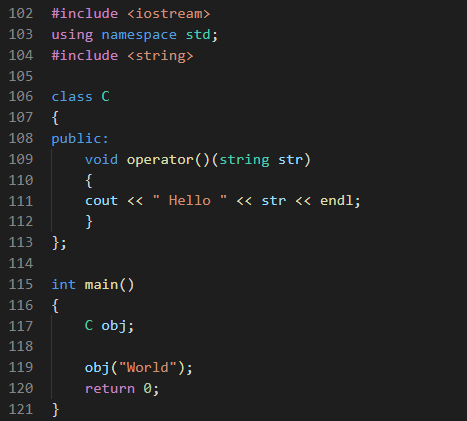
cpp_STL_Example13

Advantages of STL:

  • Reusability: STL provides a way to write generic, reusable code that can be applied to different data types. This can lead to more efficient and maintainable code.
  • Efficient algorithms: Many of the algorithms and data structures in the STL are implemented using optimised algorithms, which can result in faster execution times compared to custom code.
  • Improved code readability: The STL provides a consistent and well-documented way of working with data, which can make your code easier to understand and maintain.

Disadvantages of STL:

  • Learning curve: The STL can be difficult to learn, especially for beginners, due to its complex syntax and use of advanced features like iterators and function objects.
  • Lack of control: When using the STL, you have to rely on the implementation provided by the library, which can limit your control over certain aspects of your code.


C++, Programming, STL Tags:STL

Post navigation

Previous Post: Class Templates
Next Post: Vector in C++ STL

More Related Articles

C program to convert Binary to Decimal number system C Programming
C program to check positive, negative or zero using simple if or if else C Programming
unordered_multimap in C++ STL C++
C program to convert Binary to Octal number system C Programming
C program to print number in words C Programming
Templates in C++ C++

Leave a Reply Cancel reply

Your email address will not be published. Required fields are marked *

Archives

  • May 2026
  • August 2025
  • March 2025
  • February 2025
  • January 2025
  • December 2024
  • August 2024
  • April 2024
  • March 2024
  • February 2024
  • January 2024
  • December 2023
  • November 2023
  • September 2023
  • February 2023
  • February 2022
  • January 2022
  • December 2021
  • November 2021
  • October 2021

Categories

  • Algo
  • Array in C
  • C Programming
  • C++
  • C++
  • Company Wise
  • Competitive Programming
  • Design Pattern
  • DS
  • DS & Algo
  • Fast and Slow Pointer
  • fixed size sliding window
  • General
  • GFG
  • GFG PTOD
  • HLD
  • hld101
  • Interview Prep Sheet
  • Interview Questions
  • Leetcode Problems
  • Leetcode PTOD
  • LLD
  • Low-level design
  • Mastering in C programming (Crash Course)
  • Neetcode 150
  • Programming
  • Roadmap
  • Setup
  • Setup
  • sliding window
  • SOLID Principle
  • STL
  • string in c
  • System Design
  • TCP DSA 150
  • TCP DSA 351
  • TCP DSA 75
  • TCP HLD50
  • Top X
  • Variable size sliding window

Tags

algorithm array basic c++ coding interview C Programming Crash Course data structure and algorithm design pattern dsa easy Fixed size sliding window fubctions GFD gfg GFG PTOD hard HLD jump game LC PTOD leetcode Leetcode PTOD Leetcode Top Interview 150 LLD loop loops Low-level design Mastering C Programming in 15 Days matrix medium rotate array searching&sorting sliding window solid STL string string in c sunction in c system design TCP HLD50 TCP HLD101 Template in C++ Top Top 20 coding patterns to master MAANG Interview Top interview 150

🔥 C++ STL IN 30 MINUTES — Complete Introduction for DSA & Coding Interviews!

Confused about C++ STL while solving DSA and LeetCode problems? In this video, we’ll understand the Standard Template Library (STL) from scratch and learn the most important concepts you actually need for competitive programming, DSA, placements and coding interviews.

Instead of spending hours learning STL, this 30-minute C++ STL crash course gives you a practical overview of the most important STL components with examples and complexity.

🚀 What You'll Learn

✅ What is C++ STL?
✅ Why STL is important for DSA
✅ STL Containers
✅ Vector
✅ Pair
✅ List
✅ Stack
✅ Queue
✅ Priority Queue
✅ Set
✅ Map
✅ Unordered Map / Set
✅ Iterators
✅ Important STL Algorithms
✅ sort()
✅ reverse()
✅ find()
✅ binary_search()
✅ lower_bound()
✅ upper_bound()
✅ min() / max()
✅ Time Complexity of important STL operations
✅ How STL helps in LeetCode & Coding Interviews

💡 Why Should You Learn STL?

If you're preparing for:

🔥 LeetCode
🔥 Coding Interviews
🔥 DSA Placements
🔥 Competitive Programming
🔥 Amazon / Microsoft / Google / Meta Interviews
🔥 C++ Programming

then knowing STL can significantly reduce the amount of code you need to write and help you focus on the actual problem-solving logic.

By the end of this video, you should have a clear roadmap of which C++ STL containers, functions and algorithms you need to learn for DSA.

👉 Subscribe to TheCodePathshala for practical DSA, C++, LeetCode and System Design videos.

👍 Like the video if this STL crash course helped you!

💬 Comment below: Which STL topic confuses you the most?

#️⃣ HASHTAGS

#Cpp #CPlusPlus #STL #CPPSTL #DSA #DSAInCPlusPlus #CodingInterview #LeetCode #CompetitiveProgramming #Programming #CppProgramming #Coding #SoftwareEngineering #TheCodePathshala

SEO KEYWORDS / TAGS

c++ stl, c++ stl tutorial, c++ stl complete tutorial, c++ stl in 30 minutes, c++ stl crash course, c++ standard template library, standard template library in c++, c++ stl for dsa, c++ stl for beginners, c++ stl interview, c++ stl coding interview, c++ stl containers, c++ vector, c++ pair, c++ list, c++ stack, c++ queue, c++ priority queue, c++ set, c++ map, unordered_map c++, unordered_set c++, c++ iterators, c++ algorithms, c++ sort, c++ lower_bound, c++ upper_bound, c++ dsa, dsa in c++, leetcode c++, competitive programming c++, c++ coding interview, c++ placement preparation, c++ interview preparation, learn c++ stl, c++ stl explained, c++ stl one shot, c++ stl complete guide, c++ stl tutorial hindi, c++ stl hindi, standard template library tutorial
c++, stl, standard template library, dsa, data structures, algorithms, c++ interviews, stl introduction, c++ programming, coding interviews, competitive programming, stl functions, stl containers, learn c++, c++ basics, stl, cplus, cpp, stl, stl, cppp, alogrithms, c++ in 30 minutes, c stl, datastructure, algorithims
C++ STL IN 30 MINUTES 🔥 | Complete STL Introduction for DSA & Interviews
Important!!
Is DSA required for FAANG interview 🇮🇳♥️
Bug free code | prod ready #google #leetcode #codeprep #codeadventure #codeeveryday
2 sum in O(n) #google #microsoft
Design a system for 10 million users #Design #google #microsoft #interview
System design basic #systemdesign #apple #google
LeetCode #1 – Two Sum | Under 3 Minutes #leetcode #viral #codeeveryday #codelife
🚀 LeetCode #1 – Two Sum Explained in Under 2 Minutes!
Learn the most asked coding interview problem using the Hash Map approach and understand why it runs in O(n) time instead of O(n²).
In this Short, you'll learn:
✅ Problem statement
✅ Optimized Hash Map approach
✅ Step-by-step dry run
✅ Time & Space Complexity
✅ Interview tips
If you're preparing for FAANG, Microsoft, Amazon, Google, or any software engineering interview, this series is for you.
👍 Like the video if it helped.
💬 Comment which LeetCode problem I should explain next.
🔔 Subscribe for daily DSA, Golang, System Design, and Coding Interview content.
#leetcode #twosum #dsa #coding #programming #cpp #golang #interview #softwareengineer #shorts #codinginterview #algorithms #datastructures
🚀 LeetCode #1 – Two Sum Explained in Under 3 Minutes! #leetcode #viral #codeeveryday #codelife
Load More... Subscribe

TCP DSA

75
150
351

TCP HLD

50
101

Recent Posts

  • CAP THEOREM
  • TCP DSA 351
  • TCP HLD 101
  • TCP HLD 50
  • TCP DSA-150

    Recent Comments

    1. Odell Volner on C program to print multiplication table of a given number
    2. Crista Diegidio on C program to print multiplication table of a given number
    3. Daniel Pauling on C program to print multiplication table of a given number
    4. Tonisha Hepp on C program to print multiplication table of a given number
    5. Jorge Layng on C program to print multiplication table of a given number

    Copyright © 2026 Learn to Code and Code to Learn.

    Powered by PressBook Blog WordPress theme