
Skip to content
  • Home
  • YouTube
  • About
  • Contact
Learn to Code and Code to Learn

Learn to Code and Code to Learn

Your Journey to Code Mastery

  • Interview Prep Sheet
    • TCP DSA 75
    • TCP DSA 150
    • TCP DSA 351
    • TCP HLD 50
    • TCP HLD 101
  • General
    • Setup
    • Mastering in C programming (Crash Course)
  • DSA Patterns
    • Fast and Slow Pointer
    • sliding window
      • fixed size sliding window
      • Variable size sliding window
  • Coding Prep
    • Leetcode Problems
      • Leetcode Practice
      • Leetcode PTOD
      • TCP DSA 150
    • GFG
      • GFG Practice
      • GFG PTOD
    • Company wise Interview Questions
      • Google
      • Microsoft
  • Programming
    • C Programming
    • C++
      • C++-11
      • c++-14
      • STL
    • Python
  • HLD
    • TCP HLD 50
    • TCP HLD 101
  • LLD
    • SOLID Principle
    • Design Pattern
      • Creational Design Patterns
        • Singleton
  • Toggle search form

Day – 2/Part – 4 : Loops in C programming

Posted on December 17, 2023December 17, 2023 By thecodepathshala No Comments on Day – 2/Part – 4 : Loops in C programming

A loop statement allows programmers to execute a statement or group of statements multiple times without repetition of code. In other hand, Loops are used to repeat a block of code until the specified condition is met. 

Why we need loops?

If we need to print the table of 2, we can use multiple print statement.
// C program to illustrate need of loops
#include <stdio.h>
int main()
{
printf( "2\n");
printf( "4\n");
printf( "6\n");
printf( "8\n");
printf( "10\n");
printf( "12\n");
printf( "14\n");
printf( "16\n");
printf( "18\n");
printf( "20\n");

return 0;
}


In other hand, we can use loop and print the table. There will be less line of code.
// C program to illustrate need of loops
#include <stdio.h>
int main()
{
for(int i=1; i<=10; i++)
{
printf( "i*2\n");
}
return 0;
}


There are mainly two types of loops:

  1. Entry Controlled loops: In Entry controlled loops the test condition is checked before entering the main body of the loop. For Loop and While Loop is Entry-controlled loops.
  2. Exit Controlled loops: In Exit controlled loops the test condition is evaluated at the end of the loop body. The loop body will execute at least once, irrespective of whether the condition is true or false. do-while Loop is Exit Controlled loop.
Types of Loop in C

There are 3 types of Loop in C language, namely:

  1. for loop : first Initializes, then condition check, then executes the body and at last, the update is done.
  2. while loop : first Initializes, then condition checks, and then executes the body, and updating can be inside the body.
  3. do while loop : do-while first executes the body and then the condition check is done.
1. for loop

The for loop in C is used to execute a set of statements repeatedly until a particular condition is satisfied. We can say it is an open ended loop. 

Syntax :

for(initialization; condition; increment/decrement)
{
statement-block;
}

The for loop is executed as follows:

  1. It first evaluates the initialization code.
  2. Then it checks the condition expression.
  3. If it is true, it executes the for-loop body.
  4. Then it evaluate the increment/decrement condition and again follows from step 2.
  5. When the condition expression becomes false, it exits the loop.

    Flowchart:
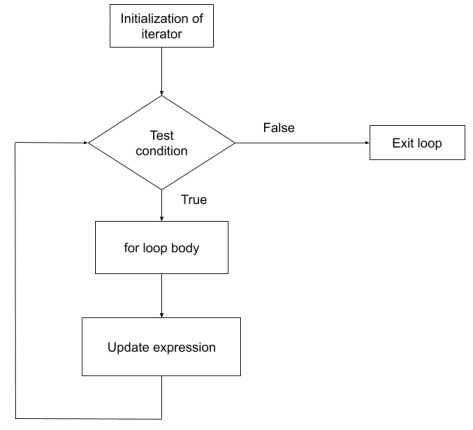
We first initialize our iterator. Then we check the condition of the loop. If it is false, we exit the loop and if it is true, we enter the loop. After entering the loop, we execute the statements inside the for loop, update the iterator and then again check the condition. We do the same thing unless the test condition returns false.

Example :
Program to print first 10 natural numbers using for loop

#include<stdio.h>
void main( )
{
    int x;
    for(x = 1; x <= 10; x++)
    {
        printf("%d\t", x);
    }
}

/*
Output:
1 2 3 4 5 6 7 8 9 10
*/

Nested for loop :

We can also have nested for loops, i.e one for loop inside another for loop in C language. This type of loop is generally used while working with multi-dimensional arrays.

Syntax:

for(initialization; condition; increment/decrement)
{
for(initialization; condition; increment/decrement)
{
statement ;
}
}

Example:
Program to print half Pyramid of numbers using Nested loops

#include<stdio.h>

void main( )
{
    int i, j;
    /* first for loop */
    for(i = 1; i < 5; i++)
    {
        printf("\n");
        /* second for loop inside the first */
        for(j = i; j > 0; j--)
        {
            printf("%d", j);
        }
    }
}

/*
Output :

1
21
321
4321
54321
*/
2. While Loop

While loop does not depend upon the number of iterations. If the condition will become false then it will break from the while loop else body will be executed.

The while loop is an entry controlled loop. It is completed in 3 steps.

  • Variable initialization.(e.g int x = 0;)
  • condition(e.g while(x <= 10))
  • Variable increment or decrement ( x++ or x-- or x = x + 2 )

Syntax:
variable initialization;
while(condition)
{
statements;
variable increment or decrement;
}

Flowchart for while loop:
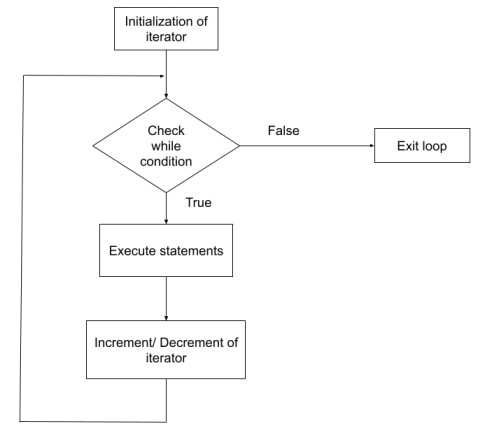
We can see that firstly, we initialize our iterator. Then we check the condition of while loop. If it is false, we exit the loop and if it is true, we enter the loop. After entering the loop, we execute the statements inside the while loop, update the iterator and then again check the condition. We do the same thing unless the condition is false.

Program to print first 10 natural numbers using while loop

#include<stdio.h>
void main( )
{
    int x;
    x = 1;
    while(x <= 10)
    {
        printf("%d\t", x);
        /* below statement means, do x = x+1, increment x by 1 */
        x++;
    }
}

/*
Output:
1 2 3 4 5 6 7 8 9 10
*/
3. do-while Loop

There is some situation where we execute body of the loop once before testing the condition. Such situations can be handled with the help of do-while loop.
The do-while loop is similar to a while loop but the only difference lies in the do-while loop test condition which is tested at the end of the body. In the do-while loop, the loop body will execute at least once irrespective of the test condition.

Syntax:

initialization_expression;
do
{
    // body of do-while loop
    
    
    update_expression;

} while (test_expression);

Flowchart for do-while loop:
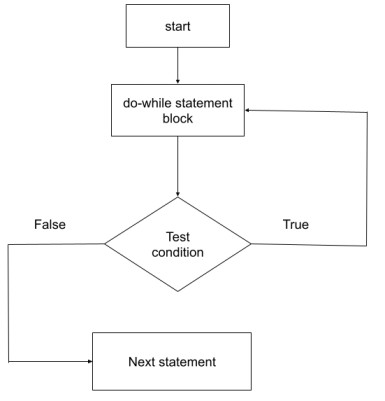
We initialize our iterator. Then we enter body of the do-while loop. We execute the statement and then reach the end. At the end, we check the condition of the loop. If it is false, we exit the loop and if it is true, we enter the loop. We keep repeating the same thing unless the condition turns false.

Example :
Program to print first 10 natural numbers using while loop

#include<stdio.h>
void main( )
{
    int x;
    x = 1;
    do
    {
        printf("%d\t", x);
        /* below statement means, do x = x+1, increment x by 1 */
        x++;
    }
    while(x <= 10);
}

/*
Output:
1 2 3 4 5 6 7 8 9 10
*/

Infinite Loops

We come across infinite loops in our code when the compiler does not know where to stop. It does not have an exit. This means that either there is no condition to be checked or the condition is incorrect.

// for loop

#include <stdio.h>
int main()
{
    for(int i = 0; ; i++)
        printf("Infinite loop\n");
    return 0;
}

// while loop

#include <stdio.h>
int main()
{
    int i = 0;
    while(i == 0)
        printf("Infinite loop\n");
    return 0;
}

// do-while loop
#include <stdio.h>
int main()
{
    do{
        printf("Infinite loop\n");
    } while(1);
    return 0;
}

Jumping Out of Loops

while executing a loop, it becomes necessary to skip a part of the loop or to leave the loop as soon as certain condition becomes true.
For jumping out fro the loop, we use break and continue statement.
To learn about break and continue Please check break and continue statement.
7. Jump Statements
7.1 Break
7.2 Continue

Mastering in C programming (Crash Course) Tags:Mastering C Programming in 15 Days

Post navigation

Previous Post: Day – 2/Part – 3 : Decision Making and Control Statements in C
Next Post: Day 3 : Questions list

More Related Articles

Functions in C Programming Mastering in C programming (Crash Course)
ROADMAP : Mastering C Programming in 15 Days – From Basics to Advanced (Crash course) General
Day-2 / Part – 1 : Basic Input and Output in C Mastering in C programming (Crash Course)
Day 3 : Questions list Mastering in C programming (Crash Course)
Strings in C C++
Day – 2/Part – 3 : Decision Making and Control Statements in C Mastering in C programming (Crash Course)

Leave a Reply Cancel reply

Your email address will not be published. Required fields are marked *

Archives

  • May 2026
  • August 2025
  • March 2025
  • February 2025
  • January 2025
  • December 2024
  • August 2024
  • April 2024
  • March 2024
  • February 2024
  • January 2024
  • December 2023
  • November 2023
  • September 2023
  • February 2023
  • February 2022
  • January 2022
  • December 2021
  • November 2021
  • October 2021

Categories

  • Algo
  • Array in C
  • C Programming
  • C++
  • C++
  • Company Wise
  • Competitive Programming
  • Design Pattern
  • DS
  • DS & Algo
  • Fast and Slow Pointer
  • fixed size sliding window
  • General
  • GFG
  • GFG PTOD
  • HLD
  • hld101
  • Interview Prep Sheet
  • Interview Questions
  • Leetcode Problems
  • Leetcode PTOD
  • LLD
  • Low-level design
  • Mastering in C programming (Crash Course)
  • Neetcode 150
  • Programming
  • Roadmap
  • Setup
  • Setup
  • sliding window
  • SOLID Principle
  • STL
  • string in c
  • System Design
  • TCP DSA 150
  • TCP DSA 351
  • TCP DSA 75
  • TCP HLD50
  • Top X
  • Variable size sliding window

Tags

algorithm array basic c++ coding interview C Programming Crash Course data structure and algorithm design pattern dsa easy Fixed size sliding window fubctions GFD gfg GFG PTOD hard HLD jump game LC PTOD leetcode Leetcode PTOD Leetcode Top Interview 150 LLD loop loops Low-level design Mastering C Programming in 15 Days matrix medium rotate array searching&sorting sliding window solid STL string string in c sunction in c system design TCP HLD50 TCP HLD101 Template in C++ Top Top 20 coding patterns to master MAANG Interview Top interview 150

C++ Vector + 20 Minutes + Complete Tutorial + DSA + Coding Interviews

Agar aap C++ mein DSA ya Coding Interview ki preparation kar rahe hain, toh ek STL container aapko sabse zyada use karna padega — Vector! 🔥

Lekin kya aapko actually pata hai ki Vector internally kaise kaam karta hai?

Normal array aur vector mein actual difference kya hai?

size() aur capacity() alag kyun hote hain?

push_back() ke peeche kya hota hai?

Aur sabse important — reserve() aur resize() mein kya difference hai?

Is video mein hum C++ STL Vector ko zero se interview level tak samjhenge — sirf functions nahi, balki vector ke internal working, memory allocation aur time complexity ko bhi understand karenge.

🚀 C++ VECTOR IN 20 MINUTES — COMPLETE GUIDE

🔥 IMPORTANT CONCEPTS

In this video, we'll understand:

✅ vector [int] v
✅ Vector vs Array
✅ Dynamic Array
✅ Contiguous Memory
✅ size()
✅ capacity()
✅ push_back()
✅ pop_back()
✅ reserve()
✅ resize()
✅ clear()
✅ empty()
✅ front() / back()
✅ operator[]
✅ Iteration
✅ Reallocation
✅ Amortized O(1) push_back()
✅ O(1) Random Access
✅ Vector Time & Space Complexity
✅ Interview-oriented Vector usage

🧠 SIZE vs CAPACITY

size() → Vector mein currently kitne elements hain.

capacity() → Current allocated storage mein maximum kitne elements fit ho sakte hain without another allocation.

Example:

vector[int] v;

v.push_back(10);
v.push_back(20);
v.push_back(30);

cout - v.size();
cout - v.capacity();

Size aur capacity ka difference samajhna vector ke internal working ko samajhne ke liye extremely important hai.

⚡ push_back() INTERNALLY KYA KARTA HAI?

Jab vector ke paas extra capacity hoti hai, push_back() new element ko available storage mein add kar deta hai.

Lekin jab:

size == capacity

toh vector ko larger memory block allocate karke existing elements ko move/copy karna pad sakta hai. Isi wajah se individual reallocation expensive ho sakti hai, although push_back() ka amortized complexity O(1) hota hai.

🚀 reserve() vs resize()

reserve(n)
→ Future growth ke liye capacity reserve karta hai.
→ Existing size ko change nahi karta.

resize(n)
→ Vector ke actual number of elements ko change karta hai.
→ Elements add ya remove ho sakte hain.

Ye dono functions coding interviews mein frequently confuse kiye jaate hain.

🎯 VECTOR INDEXING O(1) KYUN HAI?

Vector elements contiguous memory mein store hote hain.

Isliye:

v[i]

ko direct address calculation ke through access kiya ja sakta hai.

Conceptually:

address = base_address + i × sizeof(element)

Isi wajah se vector random access O(1) provide karta hai.

💼 CODING INTERVIEWS MEIN VECTOR

Vector DSA problems mein bahut commonly use hota hai:

🔥 Two Sum
🔥 Sliding Window
🔥 Prefix Sum
🔥 Sorting Problems
🔥 Binary Search
🔥 Two Pointers
🔥 Matrix / 2D Vector
🔥 Dynamic Programming
🔥 Graph Representation
🔥 Frequency Arrays
🔥 LeetCode Problems

Agar aap C++ mein DSA kar rahe hain, toh Vector ko sirf ek STL function nahi, balki dynamic array ke concept ke roop mein samajhna bahut important hai.

🔔 WHO IS THIS VIDEO FOR?

This video is perfect for:

✔️ C++ Beginners
✔️ DSA Beginners
✔️ Coding Interview Preparation
✔️ Placement Preparation
✔️ LeetCode Beginners
✔️ Competitive Programming
✔️ Software Engineer Interviews

Agar aapko C++ STL ko practical DSA + interview perspective se seekhna hai, toh TheCodePathshala ko subscribe karein. 🚀

👍 Video helpful lage toh Like karein
💬 Comment karein: size() aur capacity() mein difference pehle pata tha?

🔔 Subscribe for C++, DSA, LeetCode & System Design

#Cpp #CPlusPlus #Vector #CPPSTL #STL #DSA #CodingInterview #LeetCode #CompetitiveProgramming #DSAInCPlusPlus #CPlusPlusProgramming #TheCodePathshala  #LeetCode

🔎 Tags:
c++ vector,
c++ vector tutorial,
c++ vector in 20 minutes,
c++ vector explained,
vector in c++,
vector c++ tutorial,
c++ stl vector,
c++ stl vector tutorial,
c++ vector for dsa,
c++ vector for coding interview,
vector in c++ for beginners,
c++ vector size capacity,
size vs capacity c++,
c++ vector push_back,
push_back internally c++,
c++ vector reserve resize,
reserve vs resize c++,
c++ vector internals,
how vector works in c++,
vector vs array c++,
c++ dynamic array,
c++ vector time complexity,
vector indexing o(1),
c++ vector interview questions,
vector interview questions,
c++ dsa,
dsa in c++,
c++ coding interview,
c++ placement preparation,
leetcode c++,
c++ stl tutorial hindi,
c++ vector hindi,
vector kya hai c++,
c++ vector explained hindi,
c++ vector
c++ vector explained
vector in c++
vector in c++ stl
c++ stl vector
c++ vector tutorial
c++ vector complete tutorial
c++ vector complete introduction
vector c++
vector stl
stl vector
c++ stl
c++ dsa
c++ data structures
vector data structure
dynamic array c++
array vs vector c++
vector vs array
size vs capacity c++
vector size capacity
push_back c++
push_back internally
reserve vs resize c++
vector reserve
vector resize
vector indexing
c++ coding interview
dsa interview preparation
c++ placement preparation
learn c++ stl
c++ for beginners
C++ Vector in 20 Minutes 🔥 | Complete Vector Tutorial for DSA & Coding Interviews
🔥 C++ STL IN 30 MINUTES — Complete Introduction for DSA & Coding Interviews!

Confused about C++ STL while solving DSA and LeetCode problems? In this video, we’ll understand the Standard Template Library (STL) from scratch and learn the most important concepts you actually need for competitive programming, DSA, placements and coding interviews.

Instead of spending hours learning STL, this 30-minute C++ STL crash course gives you a practical overview of the most important STL components with examples and complexity.

🚀 What You'll Learn

✅ What is C++ STL?
✅ Why STL is important for DSA
✅ STL Containers
✅ Vector
✅ Pair
✅ List
✅ Stack
✅ Queue
✅ Priority Queue
✅ Set
✅ Map
✅ Unordered Map / Set
✅ Iterators
✅ Important STL Algorithms
✅ sort()
✅ reverse()
✅ find()
✅ binary_search()
✅ lower_bound()
✅ upper_bound()
✅ min() / max()
✅ Time Complexity of important STL operations
✅ How STL helps in LeetCode & Coding Interviews

💡 Why Should You Learn STL?

If you're preparing for:

🔥 LeetCode
🔥 Coding Interviews
🔥 DSA Placements
🔥 Competitive Programming
🔥 Amazon / Microsoft / Google / Meta Interviews
🔥 C++ Programming

then knowing STL can significantly reduce the amount of code you need to write and help you focus on the actual problem-solving logic.

By the end of this video, you should have a clear roadmap of which C++ STL containers, functions and algorithms you need to learn for DSA.

👉 Subscribe to TheCodePathshala for practical DSA, C++, LeetCode and System Design videos.

👍 Like the video if this STL crash course helped you!

💬 Comment below: Which STL topic confuses you the most?

#️⃣ HASHTAGS

#Cpp #CPlusPlus #STL #CPPSTL #DSA #DSAInCPlusPlus #CodingInterview #LeetCode #CompetitiveProgramming #Programming #CppProgramming #Coding #SoftwareEngineering #TheCodePathshala

SEO KEYWORDS / TAGS

c++ stl, c++ stl tutorial, c++ stl complete tutorial, c++ stl in 30 minutes, c++ stl crash course, c++ standard template library, standard template library in c++, c++ stl for dsa, c++ stl for beginners, c++ stl interview, c++ stl coding interview, c++ stl containers, c++ vector, c++ pair, c++ list, c++ stack, c++ queue, c++ priority queue, c++ set, c++ map, unordered_map c++, unordered_set c++, c++ iterators, c++ algorithms, c++ sort, c++ lower_bound, c++ upper_bound, c++ dsa, dsa in c++, leetcode c++, competitive programming c++, c++ coding interview, c++ placement preparation, c++ interview preparation, learn c++ stl, c++ stl explained, c++ stl one shot, c++ stl complete guide, c++ stl tutorial hindi, c++ stl hindi, standard template library tutorial
c++, stl, standard template library, dsa, data structures, algorithms, c++ interviews, stl introduction, c++ programming, coding interviews, competitive programming, stl functions, stl containers, learn c++, c++ basics, stl, cplus, cpp, stl, stl, cppp, alogrithms, c++ in 30 minutes, c stl, datastructure, algorithims
C++ STL IN 30 MINUTES 🔥 | Complete STL Introduction for DSA & Interviews
Important!!
Is DSA required for FAANG interview 🇮🇳♥️
Bug free code | prod ready #google #leetcode #codeprep #codeadventure #codeeveryday
2 sum in O(n) #google #microsoft
Design a system for 10 million users #Design #google #microsoft #interview
System design basic #systemdesign #apple #google
LeetCode #1 – Two Sum | Under 3 Minutes #leetcode #viral #codeeveryday #codelife
Load More... Subscribe

TCP DSA

75
150
351

TCP HLD

50
101

Recent Posts

  • CAP THEOREM
  • TCP DSA 351
  • TCP HLD 101
  • TCP HLD 50
  • TCP DSA-150

    Recent Comments

    1. Odell Volner on C program to print multiplication table of a given number
    2. Crista Diegidio on C program to print multiplication table of a given number
    3. Daniel Pauling on C program to print multiplication table of a given number
    4. Tonisha Hepp on C program to print multiplication table of a given number
    5. Jorge Layng on C program to print multiplication table of a given number

    Copyright © 2026 Learn to Code and Code to Learn.

    Powered by PressBook Blog WordPress theme